


See Wallarm's AI Control Platform In Action
Talk to an Expert
Your Next WAF Shouldn’t Be a WAF.
Protect web applications and the APIs behind them with one WAAP platform that discovers what’s running, reads every request in full, and blocks attacks in real time. Deployed in your own environment, not just at someone else’s edge.
Deploy in your cloud, Kubernetes, or hybrid
Web apps + APIs + MCP
Run alongside your WAF before you switch
See Wallarm In Action
Your WAF is working. It’s just not enough anymore.
What changes when you replace your WAF with Wallarm
Traditional WAF
Wallarm
Signatures and known-bad patterns
Reads and decodes the request, then judges what it does
Stops reading at a fixed byte limit
Inspects the full request, without arbitrary byte limits
Single-pass decoding
Recursive decoding through nested layers
IP-centric mitigation
Request, session and IP-level enforcement
Protects the endpoints you documented
Continuously discovers the APIs you didn’t
Web-first, APIs bolted on
REST, GraphQL, gRPC, WebSocket and SOAP parsed as protocols
Discovery and blocking in separate SKUs
One platform, one console, priced on API requests
Catch what pattern matching misses.
Attackers don’t have to send obviously malicious traffic. They encode it, wrap it, and nest it. A malicious string encoded once, tucked inside a token, inside a JSON field, encoded again on top. A firewall that decodes one layer sees nothing and forwards it to your origin.
Wallarm decodes layer by layer, feeding each parser’s output into the next, until the payload is reachable and can be analyzed for what it actually does. Inspection scales with the request instead of a preset byte count, so large payloads get the same scrutiny as small ones, with no size cutoff.
How much of a request body do you inspect?
01
Request
02
Decode every layer
03
Parse the parts
04
Judge what it does
05
Block
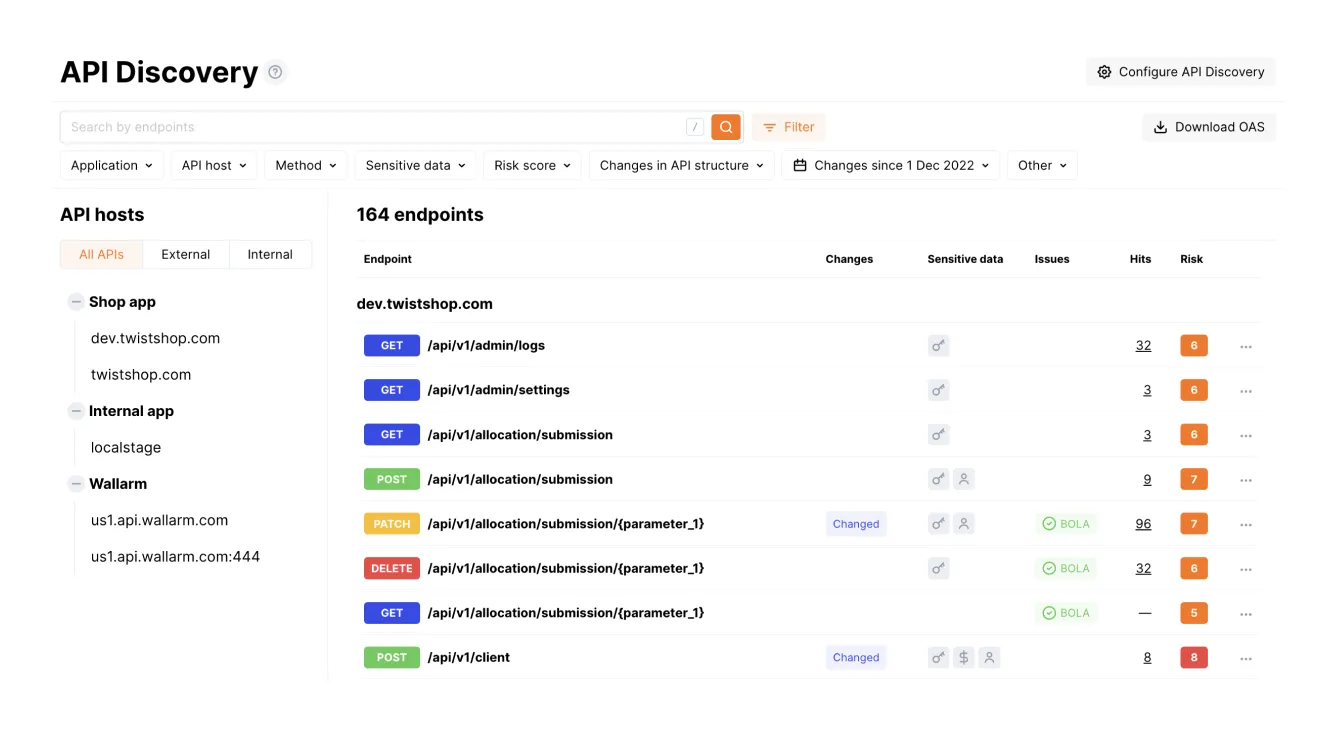
Your WAF knows URLs. Wallarm knows APIs.
1
Discover what you didn’t know existed
Continuous, automatic inventory of your APIs, including undocumented and shadow endpoints, plus scanning of public repositories and websites for leaked API keys and secrets.
2
Understand how they behave
Per-endpoint risk scoring you can tune, schema and parameter visibility, sensitive-data detection for PII, financial and medical fields, and OpenAPI enforcement with a positive security model.
3
Block attacks as they happen
Real-time enforcement at request, session, and IP level, so a malicious session stops while legitimate customers, apps, and partners keep working.
Your AI features are already API traffic.
Replace more than your WAF.
Prove it against your current WAF before you switch.
1
See what you actually have.
Wallarm discovers your APIs, endpoints and traffic patterns, including the ones that aren’t in your WAF’s ruleset or your API documentation.
2
Run Wallarm alongside your existing WAF.
Deploy in monitoring mode, compare what each product detects on your own production traffic, and tune enforcement before anything blocks.
3
Move enforcement to Wallarm.
Turn on blocking at request, session and IP level when the evidence says you’re ready. Keep your CDN and DDoS layer where it is.
Run both on your own production traffic and compare what each one catches. Then ask your incumbent to do the same.
Runs where your APIs run. Not just at someone else’s edge.
Because inspection happens in your environment, coverage extends to internal and east-west API traffic between your own services. The traffic that never reaches a public edge network at all.
Migration Paths
Thinking about replacing your current WAF?
Replace Cloudflare WAF
Inspection stops at 128 KB on all plans, and coverage is limited to traffic routed through their network. No in-cluster deployment.
Replace AWS WAF
8 KB body inspection on Application Load Balancer, with no option to raise it. GraphQL, gRPC, SOAP and WebSocket aren’t parsed as protocols. API discovery and sensitive-data classification aren’t in the product.
Replace Akamai
Two products and two enforcement paths. API Security discovers. App & API Protector blocks. 8 KB default body inspection, 32 KB maximum. No external API leak detection.
Replace Imperva
Modules licensed separately with independent cloud and self-managed SKUs. No external repository scanning. An MCP gateway is named as planned for 2026, not available today.
Replace F5
Capability depends on which product sits in the traffic path. Length violations alarm rather than block by default. On-premises API Security Local Edition is discovery and classification, not full runtime protection.
Competitive figures as of September 2026.
Before you renew your WAF, see what could replace it.
See how Wallarm protects your web applications and the APIs behind them, what it discovers that your current WAF doesn’t, and what you could consolidate along the way.