


See Wallarm's API Protection In Action
Talk to an Expert
Infrastructure
Discovery.
No per-account credentials managed by you. No DevOps ticket. No production risk.
The world's most demanding teams run on Wallarm.


%201.svg)


A finding fires in account number
847 out of 1,200. Now what?
5,000
From AWS estate to Wallarm
protection in under an hour.
Cross-account topology
Security Hub sync
IAM and least-privilege analysis
Drift detection
Customer-authored rules
One-click traffic mirroring
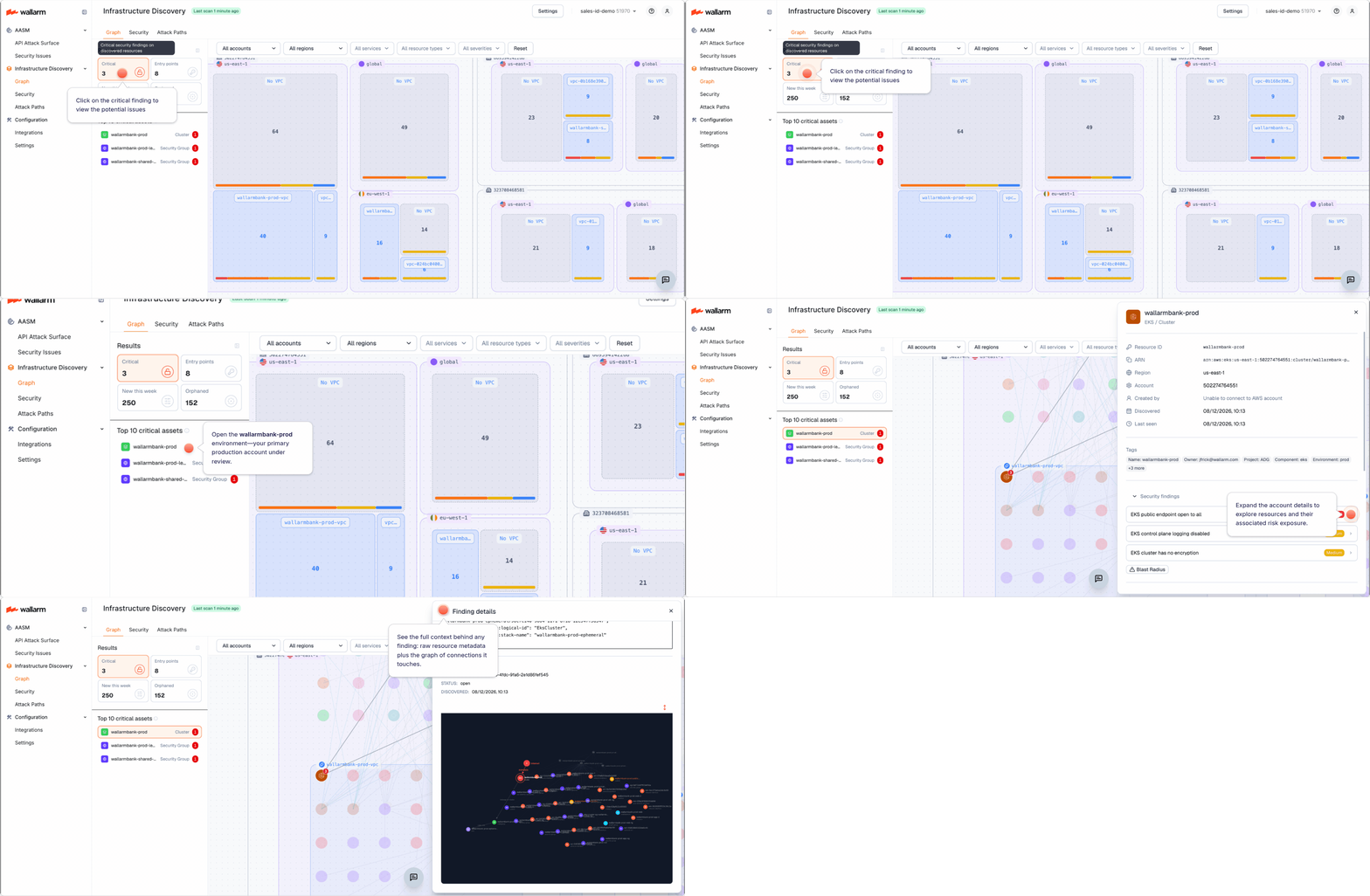
See What’s Actually Running in Your AWS Environment
Take the interactive tour to see how Wallarm maps your AWS environment, surfaces hidden risk, tracks changes, and connects discovered infrastructure to protection.
How Wallarm and AWS
work together.
Frequently asked questions
Discovery uses a read-only IAM role for resource enumeration. Traffic mirroring uses a separate, write-scoped role with disjoint permissions. Both assume cross-account access via STS with an ExternalId. You review the IAM policy before applying it, and a single API call tears down everything Wallarm provisioned.
Register each AWS account once with whichever credential method that account supports: STS role assumption with optional ExternalId, AWS SSO profile, or static access keys. Discovery runs collectors in parallel across every registered account and region.
AWS Config is a configuration recorder. Infrastructure Discovery is a protection workflow. It builds a live topology graph, classifies plain-HTTP endpoints by source type, provisions traffic mirroring on demand, and feeds the result into Wallarm protection. AWS Config can supply data, but it does not solve the problem.
No. Traffic mirroring is out-of-band and copy-only. Wallarm sees a duplicate of the traffic. Your production path is unchanged. Latency and availability are not affected. Mirroring uses VPC Traffic Mirror for small footprints and Gateway Load Balancer for multi-VPC environments, with full inspection VPC and per-spoke endpoints provisioned automatically.
Each tenant is region-locked at creation: US or EU, immutable. Dedicated RDS, separate credentials, dedicated namespace. No shared state between tenants. Wallarm Cloud receives analysis results, not raw packet captures. Customer IPs and ARNs are not stored in shared logs.
Two minutes from tenant creation to first scan. First scan results visible within five minutes of completion. From there, mirroring is one click per VPC. Time-to-first-mirrored-traffic is roughly an hour for an enterprise estate, compared to the eight-week DevOps project that has historically been the alternative.
Infrastructure Discovery is available on AWS Marketplace with a Free tier, a $200/month Professional tier, and a $500/month Enterprise tier — priced per AWS account, not per asset.