LIVE · HOW WOULD YOU LIKE TO CONSUME THIS PAGE?
Free, Hands-On API Security Certification
Close
Privacy settings
We use cookies and similar technologies that are necessary to run the website. Additional cookies are only used with your consent. You can consent to our use of cookies by clicking on Agree. For more information on which data is collected and how it is shared with our partners please read our privacy and cookie policy: Cookie policy, Privacy policy
We use cookies to access, analyse and store information such as the characteristics of your device as well as certain personal data (IP addresses, navigation usage, geolocation data or unique identifiers). The processing of your data serves various purposes: Analytics cookies allow us to analyse our performance to offer you a better online experience and evaluate the efficiency of our campaigns. Personalisation cookies give you access to a customised experience of our website with usage-based offers and support. Finally, Advertising cookies are placed by third-party companies processing your data to create audiences lists to deliver targeted ads on social media and the internet. You may freely give, refuse or withdraw your consent at any time using the link provided at the bottom of each page.
Thank you! Your submission has been received!
Oops! Something went wrong while submitting the form.
Discover · Protect · Respond

API Security
that works.

Wallarm API Security is a real-time API protection platform that discovers every API in your estate, blocks OWASP API Top 10, abuse, and account takeover inline, and gives security teams the data to triage what gets through, across REST, GraphQL, gRPC, SOAP, and WebSocket, with no spec required.

One platform. Zero tuning.
Get A Demo
REST, GraphQL, gRPC, SOAP, WS
No spec required
Trusted By

The world's most demanding teams run on Wallarm.

The Problem

Three problems your WAF
was never designed to solve.

API security is not a flavor of web application security. The attacks are different, the tools that catch them are different, and the gaps are different.
Problem
What it looks like
Cost of missing it
Rogue APIs
Shadow APIs deployed without security review. Zombie APIs that should have been retired.
X The first place you'll learn the API existed is the breach report.
API abuse
Bots scraping your data. Automated tools probing rate limits. Aggregators pulling pricing 24/7.
X Infrastructure cost. Inventory exhaustion. Competitive pricing exposure.
Account takeover
Credential stuffing at scale. Distributed login attempts. Slow brute force across thousands of IPs.
X Customer fraud. Reputation. Regulatory exposure.
The unmanaged half

<50%

of enterprise APIs are properly managed. The other half is your attack surface.
Source: Gartner
The Solution
Part of the AI Control Loop

Discover, protect, respond.
One platform.

Wallarm API Security is the API protection layer of the AI Control Loop, the foundation that makes Observe, Enforce, and Govern possible. Discovery and protection have to work before anything else in the loop can. It gives you continuous visibility into every API your business runs, blocks attacks in real time across REST, GraphQL, gRPC, SOAP, and WebSocket, and gives the SOC the data to triage what gets through. No spec required. No signatures to maintain.
1
Discover

Discover and inventory

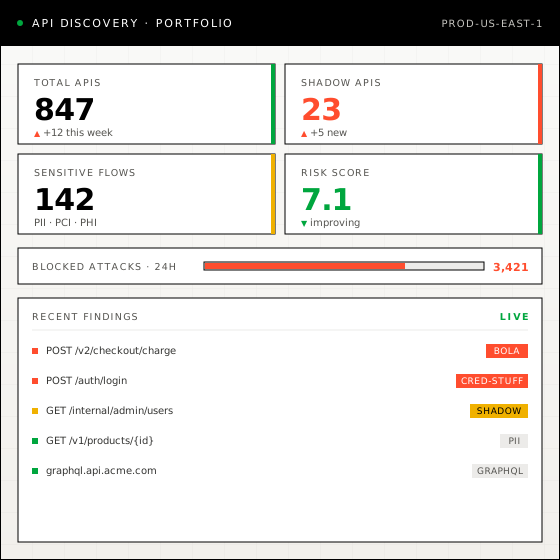
Find every API including shadow, zombie, and rogue. Auto-build OpenAPI specs from live traffic. Surface sensitive data in transit. Covers external attack surface too.
2
Protect

Block API attacks in real time

Stop OWASP API Top 10, injections, BOLA, broken auth, and 0-days across REST, GraphQL, gRPC, SOAP, and WebSocket. No signatures.
3
Abuse

Stop API abuse

Detect credential stuffing, account takeover, malicious bots, and L7 DDoS by behavior, not signatures. Blocks at the session, not the IP.
4
Sensitive Data

Track sensitive data

Surface every API moving PII, payment data, credentials, or health records. Map it to compliance scope. Alert on changes.
5
Leaks

Catch leaked API keys

Continuously scan public sources for leaked API keys, tokens, and credentials tied to your domains. Revoke before someone else uses them.
6
Respond

Respond and integrate

Drill into every malicious request. Push events to Splunk, Sumo, QRadar, Jira, PagerDuty, OpsGenie, Slack. Active Threat Verification surfaces only real incidents.
Comparison

Wallarm vs Salt vs Traceable vs Akamai

Wallarm blocks inline. Salt and Traceable detect and alert. For buyers who need to stop an attack rather than write a ticket about one, the distinction matters.
Wallarm
Salt
Traceable
Akamai
Read The Comparison
FAQ

Frequently asked questions

Side-by-side comparison of API Security platforms across capability, deployment, false positive rate, and TCO.
How is Wallarm API Security different from Salt or Traceable?

Wallarm protects in real time inline. Salt and Traceable focus on detection and posture; they don't block traffic. If you want to stop the attack instead of write a ticket about it, you need an inline platform. Wallarm also covers REST, GraphQL, gRPC, SOAP, and WebSocket from one engine; competitors typically focus on REST and bolt the rest on.

Do you need an OpenAPI spec to start protecting an API?

No. Wallarm builds a spec from live traffic so you can start with what you actually run, not what you intended to run. If you do have a spec, upload it for testing. Both work.

How does Wallarm block attacks?

Three ways, each suited to a different attack type. Single-request blocking stops surgical attacks like SQL injection and path traversal at the request level. Session blocking stops behavioral attacks and IP rotation by terminating the entire authenticated session. IP blocking is the right move for geofencing and large-scale abuse where you want the source off your network. Wallarm picks the right one automatically based on the attack pattern, or you can set the policy yourself.

What types of API attacks does Wallarm block?

OWASP API Security Top 10, injection attacks (SQLi, XSS, RCE), broken object-level authorization (BOLA), broken function-level authorization, broken auth, server-side request forgery, and 0-day exploits. Plus API abuse: credential stuffing, account takeover, scraping bots, and L7 DDoS. All on the same platform.

How do you stop credential stuffing without blocking legitimate users?

Behavior, not signatures. Wallarm correlates request sequences across sessions to find the patterns of automated credential stuffing (volume, distribution, header anomalies, response timing) and blocks the abuse pattern, not the user. Legitimate logins from the same network keep working.

Does this work for shadow and zombie APIs?

Yes. Discovery runs on live traffic, so any API actually serving requests shows up regardless of whether it's documented or supposed to exist. Shadow APIs (undocumented), zombie APIs (forgotten), and rogue APIs (unauthorized) all surface in the inventory.

What about API keys leaked on GitHub?

API Leak Management continuously scans public sources for credentials tied to your domains. When something matches, you get an alert with the source, the credential, and the scope. Revoke before someone else uses it.

The AI Control Loop

You can't observe what you haven't discovered. You can't enforce what you haven't protected. Wallarm API Security is the foundation layer — the discovery and protection surface that every other loop step depends on. Add AI Hypervisor for runtime agent observability. Add Infrastructure Discovery for cloud asset coverage. The loop closes when all three run together.

See it run
on your APIs.

30-minute walkthrough on a live API Discovery dashboard. Real traffic, real findings.
Get A Demo