Join us for a webinar, "The CISO Workshop on API Threat Modeling
Close
Privacy settings
We use cookies and similar technologies that are necessary to run the website. Additional cookies are only used with your consent. You can consent to our use of cookies by clicking on Agree. For more information on which data is collected and how it is shared with our partners please read our privacy and cookie policy: Cookie policy, Privacy policy
We use cookies to access, analyse and store information such as the characteristics of your device as well as certain personal data (IP addresses, navigation usage, geolocation data or unique identifiers). The processing of your data serves various purposes: Analytics cookies allow us to analyse our performance to offer you a better online experience and evaluate the efficiency of our campaigns. Personalisation cookies give you access to a customised experience of our website with usage-based offers and support. Finally, Advertising cookies are placed by third-party companies processing your data to create audiences lists to deliver targeted ads on social media and the internet. You may freely give, refuse or withdraw your consent at any time using the link provided at the bottom of each page.
Thank you! Your submission has been received!
Oops! Something went wrong while submitting the form.
/
/
API Security

API Security Tutorial

In 2025, API security has become the most critical battlefield in cybersecurity. With 99% of organizations reporting API security incidents and over 50% of all exploited vulnerabilities tracked by CISA now being API-related, they have become the primary attack surface for adversaries. By 2026, 80% of enterprises will have deployed AI applications or APIs in production, with AI Security Platforms becoming mandatory as the threat landscape accelerates.

API Security Tutorial

What is API Security?

API security is the process of protecting APIs from attacks and unauthorized access. It encompasses implementing authentication, authorization, encryption, and continuous monitoring protocols to ensure that only authorized users and applications can access these interfaces.

APIs serve as the connective tissue of modern enterprise architecture, linking microservices, cloud platforms, mobile applications, AI systems, and third-party integrations. With this critical role comes critical risk. Unlike traditional web applications, APIs lack human interaction patterns, making them inherently prone to automation-based abuse and difficult to protect with conventional security tools.

Why is API Security Important?

2025 Reality: The API Security Crisis

Incident Frequency:

  • 99% of organizations reported API security incidents in 2025 (up from 84% in 2024)
  • 84% experienced at least one API-related incident in 2024
  • 57% experienced multiple API-related incidents in 2024
  • 40,000+ API incidents documented in H1 2025 alone
  • 1 in 4 companies faced cyberattacks in early 2024

Vulnerability and Exploitation Surge:

  • 50.3% of all CISA known exploited vulnerabilities are now API-related (2024) a 30% increase from 2023
  • 439 AI-related CVEs tracked in 2024 (1,025% increase from 2023)
  • 99% of AI CVEs are directly tied to APIs
  • 605 security misconfiguration incidents recorded in Q3 2025 (33% quarter-over-quarter growth)

Real-World Impact:

  • T-Mobile breach (January 2024) exposed 37 million customers through API vulnerability
  • 42% of organizations discovered shadow APIs only after security incidents
  • 27% of API-focused DDoS traffic targeted financial services (H1 2025)
  • 95% of API attacks originated from authenticated sessions (2025)

Attack Sophistication and Volume

What Makes 2025 Different:

  • 44% of advanced bot traffic now targets APIs up from 30% in 2024
  • 30% of API attacks involve malicious bots
  • Business logic attacks account for 27% of all API attacks (10% increase from 2024)
  • Newly deployed APIs discovered and exploited in as little as 29 seconds
  • AI agents operate at machine speed with persistent, automated attack patterns
  • Automated threats dominate, with coordinated, high-velocity attacks difficult for traditional tools to detect

AI-Driven API Risks Escalating

Enterprise AI API Security Gaps (2025 Data):

  • 57% of AI-powered APIs are externally accessible to the internet
  • 89% rely on weak authentication mechanisms (static keys or basic HTTP auth)
  • Only 11% use robust security methods (bearer tokens, JWTs with expiration)
  • 63% of enterprise leaders believe AI increases API security risk
  • 12% of enterprises are still waiting for security controls before deploying AI
  • 51% of developers worry about unauthorized/excessive API calls from AI agents

Financial and Operational Impact

  • Compromised APIs expose PII/PHI, financial data, and confidential business information
  • API breaches routinely expose millions of records from a single vulnerability
  • API and bot attacks responsible for 11% of global cyber losses
  • Billions in annual business losses from API-based fraud, credential theft, and service disruptions
  • Organizations paying for expensive API security solutions yet finding them inadequate for their expanding API footprint

Why Traditional Security Fails

Legacy Problem: Traditional WAFs and application security tools were designed for human-like traffic patterns, assuming:

  • Predictable request sequences
  • Browser-based clients with verifiable environments
  • Known attack signatures

API Reality:

  • Non-browser clients (microservices, AI agents, mobile apps) lack human verification
  • Legitimate-looking malicious requests bypass signature-based detection
  • Machine-speed automation overwhelms signature-based rules
  • Rapid API evolution requires constant manual tuning
  • Shadow APIs expand the attack surface faster than tools can scan

The Bottom Line: With microservices, serverless, and cloud-native architectures, almost every enterprise application now depends on APIs. API security has become a core component of modern cybersecurity.

API Security vs APP Security

Firewalls are great, but they weren’t built to understand how APIs work.

Traditional Web Application Security Approach

Traditional WAFs and application firewalls were built on a "castle and moat" model:

  • Clear network perimeter with controlled access points
  • Static protocol adherence (HTTP requests follow predictable patterns)
  • Browser-based clients (WAFs can verify browser environments, detect headless browsers/bots)
  • Known attack patterns (XSS, DDoS, SQL injection detected via signatures)

This model worked well for decades because attackers had to act within human constraints and WAFs could learn and enforce consistent rules.

API Security Challenges: Why Everything is Different

1. Massive and Rapidly Expanding Attack Surface

The Problem:

  • APIs have numerous endpoints using different protocols: REST, GraphQL, gRPC, SOAP, WebSocket, Webhooks
  • Organizations typically manage 10-20% more active APIs than they believe they have (shadow APIs)
  • By 2026, less than 40% of enterprise APIs will be actively managed (Gartner)
  • 60% of enterprises will lag in digital transformation due to lack of API discovery capabilities

Why It Matters: Every undiscovered API is an attack vector. Every new API deployment that bypasses traditional security controls becomes a potential breach point.

2. Rapid and Continuous API Evolution

The Problem:

  • APIs evolve rapidly in DevOps and continuous deployment environments
  • New API versions, endpoint modifications, and schema changes happen daily
  • Traditional WAFs cannot accommodate this elasticity manual tuning required for each change
  • Configuration errors multiply with API expansion

Why It Matters: Security tools lag behind development velocity. By the time a WAF rule is written, new endpoints already exist.

3. Non-Browser Clients and Machine-Speed Threats

The Problem:

  • Most APIs are accessed by native/mobile applications, microservices, and software components not browsers
  • Cannot use browser verification to detect malicious bots (API clients don't have human signatures)
  • AI agents and automated tools operate at machine speed with persistent automated attacks
  • 95% of API attacks originated from authenticated sessions (legitimate-looking credentials)

Why It Matters: Traditional bot detection fails. Attackers appear as legitimate authenticated users. Speed of attack exceeds human response capabilities.

4. Legitimate-Looking Malicious Requests

The Problem:

  • Many API abuse attacks exploit requests that appear legitimate:
    • Valid authentication tokens (stolen or compromised)
    • Proper authorization claims (but misused for lateral movement)
    • Normal-looking parameter values (but at massive scale or unusual combinations)
  • 44% of advanced bot traffic now targets APIs
  • 27% of API-focused DDoS traffic targeted financial services (H1 2025)
  • Business logic attacks (using APIs as designed, but for malicious purposes)

Why It Matters: Signature-based detection fails. Behavior-based and anomaly detection essential.

5. AI and Automation-Based Threat Evolution

The 2025 Landscape:

  • 439 AI-related CVEs tracked in 2024 (1,025% increase from prior year)
  • 99% of AI CVEs were directly tied to APIs
  • 57% of AI-powered APIs were externally accessible
  • 89% of AI APIs relied on insecure authentication mechanisms
  • Only 11% of AI API endpoints had robust security measures
  • Threat actors increasingly use AI to discover vulnerabilities faster than defenders

Why It Matters: Machine learning-based attacks can adapt in real-time. Traditional rule-based defenses become obsolete within seconds.

OWASP API Top 10 Security Threats

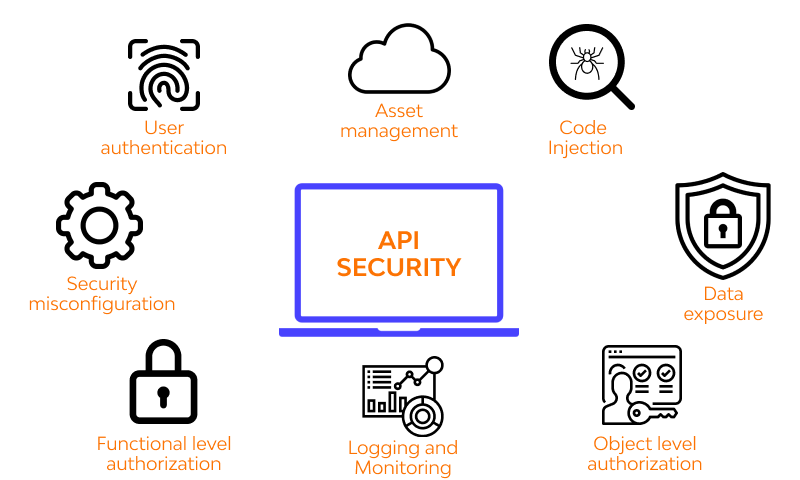
The OWASP API Security Top 10 identifies the most critical API vulnerabilities. Understanding these risks is essential for any organization developing or managing APIs.

API OWASP Top Ten
TOP-10 API Security Risks

API1:2023 - Broken Object Level Authorization (BOLA)

Issue: APIs expose endpoints handling object identifiers, creating a wide attack surface. Attackers can enumerate object IDs and access unauthorized data.

Technical Details:

  • Missing or improperly implemented object-level authorization checks
  • APIs return sensitive data based on user-provided IDs without verifying ownership
  • No validation that the requesting user should access the requested resource

Statistics:

  • Accounts for approximately 28% of all API vulnerabilities
  • One of the most exploited API vulnerabilities in practice
  • Frequently affects user profiles, account data, and sensitive records

Real Example:

text

GET /api/users/123/profile

-> Returns user 123's data (works)

GET /api/users/456/profile

-> Returns user 456's data (bypasses authorization!)

Impact:

  • Unauthorized access to data belonging to other users
  • Mass data exfiltration by changing object IDs sequentially
  • Lateral movement within applications

Mitigation:

  • Implement authorization checks in every function accessing data sources using user-provided IDs
  • Use user context from tokens/sessions, never trust client-provided user IDs
  • Verify ownership of the resource before returning data
  • Log and monitor authorization failures
  • Implement consistent authorization patterns across all endpoints

API2:2023 - Broken Authentication

Issue: Authentication mechanisms are frequently implemented incorrectly, allowing attackers to compromise authentication tokens and exploit implementation flaws.

Common Issues:

  • Weak credential validation (predictable passwords, no complexity requirements)
  • Missing or improper token validation (expired tokens still accepted)
  • Inadequate session management (no timeout, no invalidation)
  • Lack of multi-factor authentication (MFA)
  • API keys sent in URLs or logs (not in secure headers)
  • Token replay attacks (same token used multiple times)

Statistics:

  • Nearly 30% of surveyed API incidents involved broken authentication
  • Broken User Authentication (API2) ranked among the top API vulnerabilities

Impact:

  • Account takeover (temporary or permanent)
  • Identity spoofing
  • Unauthorized access to sensitive operations
  • Complete compromise of user accounts

2025 Context: Despite being well-understood, broken authentication remains prevalent due to rushed AI API deployments (89% use weak auth).

Mitigation:

  • Implement standard authentication methods only: OAuth 2.0, OpenID Connect, JWT, SAML
  • Avoid custom authentication schemes
  • Enforce strong password policies
  • Implement multi-factor authentication (MFA) for sensitive operations
  • Use secure token storage and transmission (HTTPS only, secure headers)
  • Implement proper session timeout
  • Validate tokens against token issuer
  • Invalidate tokens immediately upon logout
  • Use short-lived tokens with refresh token patterns

API3:2023 - Broken Object Property Level Authorization

Issue: Combines excessive data exposure and mass assignment. Missing or improper authorization at the object property level.

Details:

  • Missing authorization checks on individual object properties
  • Developers expose unnecessary properties in API responses
  • Mass assignment vulnerabilities (allowing modification of fields not intended for user updates)
  • No filtering of sensitive properties based on user role

Statistics:

  • Frequently appears in conjunction with BOLA attacks
  • Often results in exposure of admin flags, internal IDs, pricing data

Real Example:
API returns complete user object when only limited fields should be exposed:

json

{

  "id": 123,

  "name": "John",

  "email": "john@example.com",

  "is_admin": false,          // Should not be exposed!

  "payment_method": "visa",   // Should not be exposed!

  "internal_id": "INT-456"    // Should not be exposed!

}

Impact:

  • Information disclosure of sensitive properties (admin flags, internal IDs, payment data)
  • Data manipulation by unauthorized users
  • Mass data exfiltration

Mitigation:

  • Explicitly whitelist properties that can be modified or exposed
  • Implement property-level authorization checks
  • Filter API responses to return only necessary data per user role
  • Use schemas to enforce strict property validation
  • Implement field-level access control

API4:2023 - Unrestricted Resource Consumption

Issue: APIs require computational resources (bandwidth, CPU, memory, storage). Unrestricted consumption enables DoS, financial drain, and competitive abuse.

Resource Types:

  • Computational: Expensive database queries, complex calculations
  • Network: Large file transfers, bandwidth exhaustion
  • Financial: Paid resources (SMS, emails, API calls to external services)
  • Storage: Unlimited file uploads, data bloat

Statistics:

  • Top cause of API availability issues
  • Frequently exploited in DDoS and brute force attacks
  • Financial impact: Unexpected bills from abused paid resources

Real Examples:

  • Brute force attacks against authentication endpoints succeed (no rate limiting)
  • Credential stuffing attacks test thousands of username/password combinations
  • Expensive GraphQL queries cause server resource exhaustion
  • Large file uploads without size limits cause disk exhaustion

Impact:

  • Denial of Service (DoS) and Distributed DoS (DDoS)
  • Financial loss from excessive resource consumption
  • Service unavailability and customer impact
  • Brute force attacks succeeding due to no rate limits

Mitigation:

  • Implement rate limiting and throttling per user/IP
  • Set request size limits
  • Implement pagination with maximum result limits
  • Add timeouts to long-running operations
  • Monitor resource consumption
  • Implement quota systems for expensive operations
  • Use exponential backoff for retry logic
  • Track costs of paid resources and alert on anomalies

API5:2023 - Broken Function Level Authorization

Issue: Complex access control policies with different hierarchies, groups, and roles lead to authorization flaws, allowing privilege escalation.

Details:

  • Missing authorization checks on administrative functions
  • No separation between user and admin API endpoints
  • Role-based access control not consistently applied
  • Users able to call functions beyond their permission level

Real Example:

text

POST /api/admin/users/delete/123

-> Works when called by regular user (should only work for admins!)

GET /api/admin/settings

-> Regular user accesses sensitive configuration

Statistics:

  • Frequently exploited for privilege escalation
  • Often combined with BOLA for complete account compromise

Impact:

  • Access to functions beyond user's role
  • Administrative function execution by regular users
  • Privilege escalation
  • Unauthorized data modification or deletion
  • Complete system compromise

Mitigation:

  • Check authorization for every function and endpoint
  • Implement role-based access control (RBAC) consistently across all APIs
  • Separate user and admin endpoints with different URL paths
  • Use attribute-based access control (ABAC) for complex policies
  • Log all administrative actions
  • Implement strong authentication for admin functions
  • Use separate API keys/tokens for admin operations

API6:2023 - Unrestricted Access to Sensitive Business Flows

Issue: APIs expose business flows without compensating for automated abuse. Attackers exploit normal functionality at scale.

Details:

  • Insufficient abuse prevention mechanisms
  • Business logic not designed to prevent automation
  • No checks for suspicious patterns or excessive activity
  • Legitimate API usage abused for malicious purposes

Real Examples:

  • Ticket scalping bots: Purchasing all available concert tickets automatically
  • Account enumeration: Testing username existence through password reset flow
  • Credential testing: Automated brute force against login endpoints
  • Inventory manipulation: Depleting stock of limited items
  • Reservation abuse: Booking and canceling to hold inventory

Statistics:

  • Business logic attacks account for 27% of all API attacks (10% increase)
  • Growing area of concern as attackers focus on normal functionality abuse

Impact:

  • Financial loss from fraud and abuse
  • Service degradation from resource exhaustion
  • Unfair competitive advantage for attackers
  • Business continuity disruption

Mitigation:

  • Implement rate limiting specific to business flows
  • Add CAPTCHA or challenges for sensitive operations
  • Implement behavioral analytics to detect abuse patterns
  • Monitor unusual access patterns and concentrations
  • Add friction (delays, verification) for sensitive operations
  • Implement transaction limits
  • Track patterns of operation sequences
  • Alert on deviations from normal business patterns

API7:2023 - Server Side Request Forgery (SSRF)

Issue: APIs that fetch remote resources without validating user-supplied URIs are vulnerable to SSRF attacks.

Details:

  • User-supplied URLs used directly without validation
  • No URL whitelist or blacklist
  • Internal services accessible from API server
  • Access to cloud metadata services (AWS, GCP, Azure)

Real Example:

text

GET /api/fetch?url=http://internal-admin.local/users

-> API fetches from internal network (not allowed!)

GET /api/fetch?url=http://169.254.169.254/latest/meta-data/

-> AWS metadata service (contains credentials!)

Impact:

  • Access to internal services and metadata endpoints
  • Bypass of firewalls and VPNs
  • Internal port scanning and service enumeration
  • Credential theft from cloud metadata services
  • Complete internal network compromise

Mitigation:

  • Validate and sanitize all URLs against strict whitelist
  • Block access to private IP ranges (127.0.0.1, 10.0.0.0/8, 192.168.0.0/16, 172.16.0.0/12)
  • Block cloud metadata service endpoints (169.254.169.254, etc.)
  • Disable HTTP redirects or validate all redirect targets
  • Use network segmentation to limit API server access
  • Restrict outbound connections from API servers
  • Implement allowlist for external services

API8:2023 - Security Misconfiguration

Issue: Misconfigurations across APIs, servers, and infrastructure are the leading vulnerability type.

Common Misconfigurations:

  • Default credentials left active (admin:admin, default passwords)
  • Debug endpoints exposed in production
  • Verbose error messages revealing system information
  • Missing security headers (HSTS, CSP, X-Frame-Options)
  • Unnecessary HTTP methods enabled (PUT, DELETE when not needed)
  • Overly permissive CORS configuration (Access-Control-Allow-Origin: *)
  • Exposed API documentation
  • Unnecessary features enabled
  • Outdated dependencies with known vulnerabilities

Q3 2025 Data:

  • Security Misconfiguration led all vulnerability types with 605 cases
  • 33% quarter-over-quarter growth from Q2 2025
  • Most common root cause across all API incidents

Impact:

  • Complete system compromise
  • Information disclosure
  • Unauthorized access
  • Service takeover
  • Data exfiltration

Mitigation:

  • Implement automated security hardening
  • Remove and disable default credentials
  • Disable debug endpoints in production
  • Implement comprehensive error handling without information disclosure
  • Set security headers on all responses
  • Minimize HTTP methods to required only
  • Configure CORS restrictively (specific origins)
  • Keep API documentation internal in production
  • Regularly audit and update configurations
  • Remove unnecessary features and dependencies
  • Keep all software updated

API9:2023 - Improper Inventory Management

Issue: APIs expose more endpoints than traditional web applications, making documentation and version management critical.

Details:

  • Incomplete API inventory
  • Deprecated API versions still accessible and exploited
  • Debug endpoints exposed in production
  • Missing or outdated API documentation
  • Unmanaged zombie and shadow APIs
  • Difficult to track all endpoints across large organizations

Statistics:

  • Only 27% of organizations fully map API endpoints that expose sensitive data
  • By 2025, fewer than half of all APIs will be actively managed
  • 42% of organizations discover shadow APIs only after security incidents

Impact:

  • Increased attack surface
  • Exploitation of deprecated versions
  • Compliance violations
  • Data breaches through forgotten endpoints

Mitigation:

  • Maintain complete inventory of all APIs (internal and external)
  • Document all API endpoints and versions
  • Implement API versioning strategy
  • Retire deprecated APIs completely (not just "stop promoting")
  • Monitor for shadow APIs using API discovery tools
  • Regularly audit endpoints for debug/test functionality
  • Version control all API specifications
  • Implement API lifecycle management

API10:2023 - Unsafe Consumption of APIs

Issue: When integrating with third-party APIs, developers often trust third-party data more than user input, adopting weaker security standards.

Details:

  • Insufficient validation of third-party API responses
  • Trusting external data without sanitization
  • Inadequate error handling for API failures
  • No security assessment of integrated APIs
  • Supply chain vulnerabilities through third-party integrations

Real Example:
Integrating a third-party service without validating responses:

javascript

// VULNERABLE: Trusting third-party data

const userData = await thirdPartyAPI.getUser(id);

database.save(userData);// Directly saves external data!

Statistics:

  • Growing concern as API ecosystem expands
  • Supply chain API risks becoming critical focus
  • Third-party API compromises cascading to dependent services

Impact:

  • Compromise through trusted third parties
  • Data injection attacks
  • Service degradation
  • Supply chain attacks

Mitigation:

  • Validate all third-party API responses against expected schema
  • Sanitize all data from third-party APIs
  • Implement proper error handling for API failures
  • Assess security posture of third-party APIs before integration
  • Monitor third-party APIs for changes or suspicious behavior
  • Implement rate limiting for third-party integrations
  • Use API gateways as intermediaries
  • Verify integrity of data from third parties
  • Implement circuit breakers for failed third-party APIs

The different types of API security:

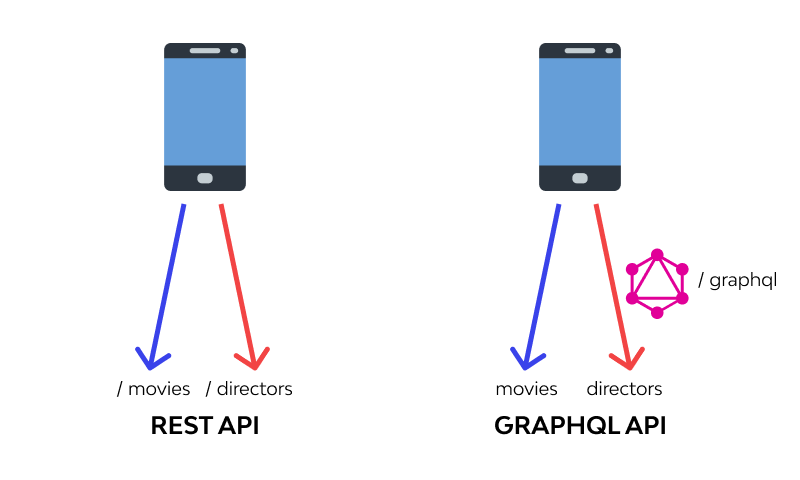
Based on the requirements, APIs can be used in various forms and styles. The chosen API style (REST, SOAP, GraphQL, gRPC, Websocket or Webhooks) decides how API security should be applied and implemented.  Different API protocols, such as gRPC, GraphQL, and others, introduce their own unique security threats and attack vectors. For instance, GraphQL, due to its flexible querying capability, can be prone to resource exhaustion attacks if queries aren't properly validated and rate-limited. Each protocol, with its distinct architectural and operational nuances, requires specialized security considerations to address potential vulnerabilities and defend against tailored exploitation techniques.

REST API Security vs SOAP Security

There are two main architectural styles used in modern APIs, each with distinct security implications.

REST API Security

Overview: Representational State Transfer uses HTTP/HTTPS and HTTP methods (GET, POST, PUT, DELETE, PATCH) for resource manipulation.

Architecture Characteristics:

  • Stateless communication
  • Resource-based (URLs represent resources)
  • HTTP method-based operations
  • JSON data format (typically)
  • Simple and widely adopted

Security Strengths:

  • Simplicity aids understanding and implementation
  • HTTPS provides solid transport security
  • Leverages HTTP best practices
  • Stateless nature reduces session management complexity
  • Mature tooling and standards available

Security Weaknesses:

  • No built-in security mechanisms – must be explicitly implemented
  • Requires explicit authentication/authorization implementation
  • Vulnerable to common web attacks if not properly protected
  • Easy to abuse if rate limiting not implemented
  • Simple format can be easily generated by automated attacks

Key Security Requirements for REST APIs:

  • OAuth 2.0 for authentication (not custom schemes)
  • HTTPS for all communications (TLS 1.2 minimum, TLS 1.3 preferred)
  • Comprehensive input validation and sanitization
  • Rate limiting to prevent abuse
  • API gateway protection for centralized security
  • Proper error handling (no information disclosure)
  • Request/response logging and monitoring
  • Authorization checks at every endpoint

Best Practices:

  • Use token-based authentication (OAuth 2.0, JWT)
  • Implement rate limiting per user and per endpoint
  • Deploy behind API gateway for centralized policy enforcement
  • Validate all inputs against OpenAPI specification
  • Log all requests with security context
  • Monitor for anomalies using behavioral analytics
  • Implement pagination with result limits
  • Use API versioning for compatibility and control

SOAP API Security

Overview: Simple Object Access Protocol provides structured, XML-based communication with built-in security features.

Architecture Characteristics:

  • XML message format
  • Protocol-independent (can use HTTP, SMTP, etc.)
  • Structured and formal request/response format
  • Enterprise-focused approach
  • Built-in security extensions (WS-Security)
  • WSDL (Web Services Description Language) for interface definition

Security Strengths:

  • Built-in WS-Security standard for message-level encryption and signatures
  • XML signatures ensure message integrity and non-repudiation
  • XML encryption protects data confidentiality
  • SAML token support for enterprise authentication
  • WS-ReliableMessaging ensures delivery guarantees
  • Enterprise-grade security standards (W3C, OASIS)
  • Support for mutual authentication and two-way TLS

Security Weaknesses:

  • Complexity can lead to misconfiguration
  • Larger message size increases network overhead
  • XML parsing vulnerabilities (XXE attacks possible)
  • Higher performance overhead
  • Older technology with legacy implementation issues
  • Requires more sophisticated security implementation

Key Security Features:

  • WS-Security for message-level security
  • XML signatures and encryption built into specification
  • Token-based authentication (SAML, X.509)
  • Built-in error handling and faults
  • Formal contract-based communication (WSDL)

Best Practices:

  • Use WS-Security for message-level encryption and signing
  • Implement SAML for enterprise authentication
  • Use SSL/TLS for transport security
  • Validate XML against schema
  • Disable XXE processing
  • Implement comprehensive logging
  • Use API management platforms for monitoring
  • Keep SOAP endpoint documentation updated

Summary: SOAP provides more security mechanisms out-of-the-box but at the cost of complexity. REST requires careful implementation but offers simplicity and agility.

Securing GraphQL APIs

GraphQL is a query language that enables clients to request specific data from an API in a structured format. Unlike traditional REST or SOAP approaches, GraphQL allows clients to define and retrieve exactly the information they need from one or multiple sources.

Since GraphQL permits highly complex queries, servers must be equipped to handle potential abuse. Without proper safeguards, excessive or malicious requests can overload the server, leading to performance issues or downtime.

Key Strategies for GraphQL Security

  • Query Timeouts – Setting a maximum execution time for each request prevents long-running queries from overwhelming system resources.
  • Depth Limitation – Restricting the depth of queries ensures that clients cannot exploit deeply nested structures to generate excessive computational loads.
  • Complexity Scoring – Assigning a complexity score to API requests based on processing demands helps restrict expensive operations that exceed a defined threshold.
  • Rate Limiting – Limiting the frequency of requests prevents repeated medium-sized queries from consuming too many server resources, ensuring balanced usage.

By implementing these measures, GraphQL APIs can be fortified against attacks and optimized for performance, minimizing risks associated with excessive or malicious queries.

API Protocol Comparison

Table: Protocol Overview

ProtocolFormatOrganized in terms ofUse cases
SOAPXML onlyenveloped message structure- Large enterprise environments
- CRM solution
- Payment gateway
- Identity management
- Healthcare, financial and telecommunication services
- Legacy system support
XML-RPCXML, HTTPhuman-readable-and-writable, script-parsable standard for HTTP-based requests and responses- Linking computers
- Connecting different types of environments
- Creating open software interfaces
MQTTbinary based protocolopen messaging- IoT and IIoT infrastructures
- Machine-to-Machine (M2M) communication
- Automotive, Industry 4.0, Transportation and Entertainment
XMPPXMLinstant messaging (IM), presence information, and contact list maintenance- Instant messaging applications
- Internet of Things (IoT)
- Online Gaming
- Social
- WebRTC, Data Syndication
RESTJSON, XML, HTML, plain textwith six architectural constraints- Public API
- Simple resource-driven apps
JSON-RPCJSONsending multiple calls to the server- Fast and reliable information exchange
- Used on Ethereum
WebhooksJSON, HTTP"user-defined HTTP callbacks"- Connection between applications
- Email marketing
- CRM solutions
GraphQLJSONschema and type system- Mobile, smartwatches and IoT API
- Complex system
- Microservices
- Creating a data schema
CoAPsimple binary base header formatmulticast support, for simple conversion to HTTP- IoT infrastructure
- Machine-to-machine (M2M) applications such as smart energy and building automation
gRPCJSON, XML, Protobuf, Thrift, Flatbufferslocal procedure call- Command and actio-oriented APIs
- D2D and D2C for embedded systems
- High perfomance communication in massive micro-services system and cloud enviroment
- Unified IPC and remote communication

Methods Of API Security Testing

Securing APIs requires systematic testing across the development lifecycle.

Test for Parameter Tampering

What It Is: Parameters in API requests can be easily manipulated. Attackers modify parameters to change behavior without authorization.

Testing Method:

  • Use browser developer tools to identify all parameters
  • Test modifying URL parameters (query strings)
  • Test modifying POST body parameters
  • Test hidden field manipulation
  • Test header manipulation
  • Verify authorization is enforced after parameter change

Real Example Attack:

text

Original request:

POST /api/purchase

{

  "product_id": 123,

  "quantity": 5,

  "amount": 500

}

Attacker modifies:

POST /api/purchase

{

  "product_id": 123,

  "quantity": 5,

  "amount": 10  // Changed to pay less!

}

What to Test:

  • Price/amount parameters
  • User ID parameters
  • Discount codes
  • Quantities
  • Permissions/roles in requests

Test for Command Injection

What It Is: Operating system command injection occurs when user input is passed to system commands without sanitization.

Testing Method:

  • Inject common OS commands and observe results
  • Try command separators: ; | & ` $()
  • Use harmless commands you can observe (e.g., whoami, id, ls)
  • Test in different parameter locations (URL, body, headers)
  • Test encoding variations (URL encoding, Base64)

Example Testing:

text

Original request:

GET /api/file?name=userfile.txt

Test injections:

GET /api/file?name=userfile.txt;ls

GET /api/file?name=userfile.txt|whoami

GET /api/file?name=userfile.txt$(id)

GET /api/file?name=userfile.txt`whoami`

What to Test:

  • Any parameter passed to system commands
  • File operations (cat, ls, find)
  • Network operations (ping, nslookup)
  • Script execution parameters

Test for API Input Fuzzing

What It Is: Fuzzing provides random or malicious data to APIs until finding functional or security problems.

Testing Method:

  • For numerical inputs: very large numbers, negative numbers, zero, float values, max/min values
  • For string inputs: special characters, SQL queries, system commands, unicode characters
  • Test boundary conditions
  • Monitor for errors, crashes, or unexpected behavior

What to Test For:

  • Error messages revealing system details
  • Unexpected responses or status codes
  • API crashes or timeouts
  • Processing of inputs incorrectly
  • Type confusion vulnerabilities

Example Fuzzing Payloads:

text

- Numerical: 999999999, -1, 0, 1.5, NaN, Infinity

- Strings: <>'"`;DROP TABLE, ../../../etc/passwd

- Unicode: 文件, 🔓, RTL override characters

- Special chars: %00, \n, \r, \t

Test for Unhandled HTTP Methods

What It Is: Web applications may accept various HTTP methods even when only some are intended.

Testing Method:

  • Test all HTTP methods against authenticated endpoints
  • Test authentication bypass through method switching
  • Try HEAD, OPTIONS, TRACE methods
  • Test CONNECT and PATCH methods
  • Check if DELETE works when POST doesn't

Real Example Vulnerability:

text

POST /api/admin/delete

-> Returns 401 Unauthorized

DELETE /api/admin/delete

-> Works! (Should require authorization)

HEAD /api/admin/delete

-> Bypasses authentication!

What to Test:

  • GET vs POST on sensitive endpoints
  • PUT/PATCH vs POST
  • DELETE vs POST
  • OPTIONS disclosure
  • TRACE method (rarely needed)

Top Open Source API Testing Tools

In 2025, as APIs continue to dominate application architectures, testing tools play a vital role in ensuring robust security and performance. Open source API testing tools help teams automate functional, load, and security tests, and identify issues early in the development pipeline. Below are some of the top open source tools actively used by security and QA teams today:

GoTestWAF

GoTestWAF by Wallarm is a powerful open-source tool for testing both traditional Web Application Firewalls (WAFs) and modern API protection solutions. It simulates real-world attacks and validates whether your API security mechanisms detect and block malicious traffic.

Key features:

  • Built-in test suites for OWASP Top 10, API Top 10, and common attack vectors

  • Supports SOAP, REST, GraphQL, gRPC, XMLRPC and WebSocket APIs

  • Custom payloads and scenarios to simulate complex attack chains

  • CI/CD-ready for automated security testing in pipelines

  • Real-time dashboards and JSON reports for integration with external systems

Postman

Postman remains a staple for API development and testing. While traditionally used for functional validation, it also supports basic security testing and automation.

Key features:

  • Automated API test suites and test scripting with JavaScript

  • CI/CD integrations via Newman CLI

  • Environment and variable management for staging vs. production

  • Response time monitoring and performance insights

  • Supports REST, SOAP, and GraphQL APIs

Swagger (OpenAPI)

Swagger (now part of the OpenAPI Initiative) continues to help teams design and document APIs. It enables testing through code generation and mock servers.

Key features:

  • Top-down and bottom-up API design options

  • Auto-generates documentation and SDKs

  • Integrates with testing tools to simulate and validate endpoints

  • OpenAPI 3.1 support with improved schema capabilities

  • Rich ecosystem of tools like Swagger Editor and Swagger UI

JMeter

Apache JMeter has evolved beyond just load testing and can now be adapted for API security testing with custom scripts and plugins.

Key features:

  • Load testing of REST, SOAP, and GraphQL APIs

  • Parameterized testing with CSV or JSON inputs

  • Integration with Jenkins, GitHub Actions, and other CI systems

  • Scripting via JSR223 (Groovy, Java) for advanced validation

  • Real-time performance metrics and visualization

SoapUI

SoapUI, both in its open-source and pro versions, is widely used for testing web services, including APIs used in enterprise systems.

Key features:

  • Supports REST, SOAP, GraphQL, and JMS APIs

  • Drag-and-drop interface for test creation

  • Assertions for security and functional validation

  • Reusable test cases across environments

  • Pro version includes advanced reporting and data-driven testing

Karate

Karate DSL combines API test automation, performance testing, and mocking in a single framework using BDD-style syntax.

Key features:

  • Write tests in Gherkin syntax with no Java code required

  • Parallel test execution and performance testing built-in

  • Mock server capabilities to simulate upstream/downstream services

  • CI/CD integrations and report generation

  • Native support for JSON, XML, and GraphQL

Fiddler Everywhere

Fiddler remains relevant as a network proxy and debugging tool with enhanced API testing capabilities.

Key features:

  • Inspect and replay HTTP/HTTPS traffic from any client

  • Modify headers, cookies, and payloads to simulate edge cases

  • Support for scripting and custom rules

  • Cross-platform support for Windows, macOS, and Linux

  • Collaboration features for teams to share sessions and test scenarios
Comparing Top Open Source API Testing Tools

API Security Best Practices:

We talked to many product security experts about where they think everyone should begin their API security program. Here is what they said.

  1. Inventory all APIs 

Security and engineering leaders should easily answer key questions: How many APIs are in use and where is sensitive data transferred? In 99% they can’t. It's crucial to have an up-to-date inventory of API methods and which of them handle PII and PHI data. While specialized products exist, open-source solutions like APIClarity can also aid in API discovery.

  1. Discovery deprecated (Zombie) and undocumented (Shadow) APIs

Zombie, Shadow, and Orphan APIs pose an enormous risk. Proper API Governance includes the process for producing and managing specifications in Dev, as well as identifying noncompliance with specs. OSS tool APIClary can help here, too. 

  1. Deploy API gateways

Utilize API gateways for managing, monitoring, and securing API traffic (note: a lot of APIs are actually unmanaged!). This adds an essential API security layer with capabilities like Rate Limiting, Caching, Authentication, Access Control, and CORS. A lot of powerful gateways are open-sourced and have premium options including Kong API Gateway and Tyk.

  1. Automate API security testing

It’s always better to discover dangerous security misconfiguration and other issues in dev environment vs in production. While not exhaustive, open-source tools like ZAP, openapi-fuzzer, and RESTler provide significant value. There is not best recipe but most companies have a combination of DAST, SAST, and IAST and devtools to help developers develop secure code (such as plugins for IDEs)

  1. Proactively look for API Leaks

API secrets leakage can lead to serious incidents. Regularly scan for exposed credentials, including API keys, in GitHub repositories, Postman collections, and similar platforms to prevent unauthorized access. Code repositories are often spots where engineers accidentally leak API keys. Find leaked credentials with tools like TruffleHog.

  1. Risk score APIs to prioritize security efforts

Don’t be overwhelmed by the number of APIs to secure. Once APIs are identified, you can prioritized testing and audit based on risk factors suitable for your specific case. Consider aspects like data sensitivity (endpoints handling PII data such as names or SSN), exposure level (external vs. internal API), and the number of parameters.

  1. Audit existing tools to make sure they support APIs

Many security tools you trusted for years, including scanners and WAFs, may not fully protect your app estate emerging API threats. Moreover, often they don't provide protection for your API stack at all - for example, they may not analyze traffic in GraphQL or gRPC. Test your tools' protocol support using open-source projects like GoTestWAF (read guide) or use our online service - API Security testing platform.

  1. Comply with the OWASP Top-10 API Security Recommendations

The best place to get familiar with API threats is the OWASP API Security Top-10, or the summary we prepared for you (see the relevant section here). This list is a must-read for both security and eng teams and provides an extensive examination of significant API vulnerabilities and mitigation techniques.

  1. Extend Beyond OWASP

Wallarm publishes quarterly and annual API ThreatStats reports covering emerging API threats, drawing from an analysis of all known CVEs and billions of observed attacks. Consider this a dynamic and up-to-date complement to the OWASP API Security Top-10

  1. Use only industry-standard methods for authentication and authorization

Do not reinvent AuthN/AuthZ methods.  Rely only on OAuth 2.0, JWT, OpenID Connect, and Bearer Tokens, or other industry standards for your authentication. Couple with stringent authorization checks at each API endpoint for access control. Even minor oversights in authorization have led to catastrophic data breaches in APIs over the past few years. 

  1. Find APIs which can be abused and get ready

APIs are developed to be consumed by software and hence inherently prone to abuse. Figure out which APIs are likely to be abused and prepare a plan of action. Rate limiting and throttling are effective but not sufficient against advanced abuses. For such cases, building protection at the application level or employing specialized products is necessary.

  1. Use encryption for external and internal microservices

In a zero-trust environment, using mTLS between microservices is a best practice.

  1. Actively enforce API policies on traffic

Thoroughly validate and sanitize all user inputs to avert typical vulnerabilities such as SQL injection, SSRF, and other forms of injection attacks. A proven strategy is to validate all API calls against their specs to screen out potentially harmful requests. An effective tool for this is the open-source API firewall, which functions as a reverse proxy, validating API requests and responses based on OpenAPI and GraphQL schemas.

  1. Implement API logging

Maintain API logs and implement real-time monitoring to detect and respond to abnormal actions (including on the session level). This can all help to isolate ongoing incidents swiftly.

  1. Pay Attention to LowCode & NoCode Tools

Be aware of the implications of LowCode and NoCode tools, especially those with direct data access, as their security aspects are often overlooked. Most of them are using APIs for integrations.

API Authentication Methods

The task of verifying users’ identity is imperative as it keeps ill-usage of API at bay and verifies user authenticity before granting him the access to the stored information kept for better Web API Security. It involves verifying the identity of someone who tries to view or edit the API resources, allowing only authenticated users for the same.

1. Host-based authentication

The host-based authentication schema is widely used for IOT devices and raw network authentication. It is not recommended for web technologies since it can be bypassed with spoofing. This process comprises verifying the host or server so that only the verified users can access resources deployed on the servers. It doesn’t demand any key or other means to initiate the process. However, the server should be competent to validate the login keys beforehand to keep the incidents of DNS spoofing, routing spoofing, and IP spoofing under control. 

In the process and manner, it’s very much similar to RSA. 

The argument used here is either yes or no. By default, no argument is set. The host-based verification of users can be done by an administrator by creating a private key for the local host or extracting the public key used for the localhost. 

2. Basic authentication

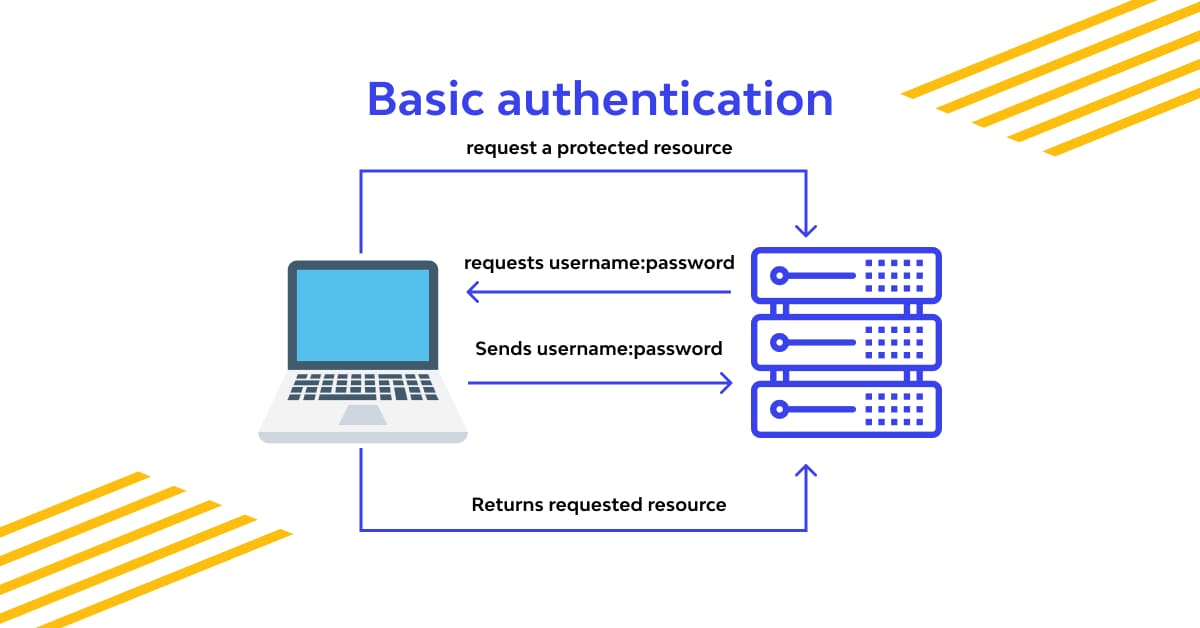
One of the most straightforward API identity-confirmation schemes, this method is crafted using HTTP protocol and process as the client dispatches an HTTP request with a pre-built header for verification of authenticity and demanding credentials like account’s password and username. This basic check is done in a browser-powered environment.

Being supported by every possible browser and server makes basic identity-confirmation the most common one. The credential details are shared over the network in the form of cleartext and are encoded using base64. The credential details are shared over the network in the form of cleartext (or base64) by default, this is a bad practice since it gives man-in-the-middle attack vectors. The good practice is to encrypt the credentials using algorithms such as RSA, SHA-256 or even custom made ones.

It is functional over proxy servers and grants access to resources not hosted on IIS servers. As it fails to add encryption, not much security can be expected out of it. Also, it’s more prone to replay attacks.

3. OAuth

OAuth is the open method of identity confirmation. It is a customary API authenticity-verification technique that covers users’ identity verification and defining authorization criteria. The protocol is used widely for allowing applications to authorize their users based on tokens, published from OAuth server (such as Google).

It requires asking for a token when someone tries logging into the system. The token serves here as the means of verifying and approving the user identity. The person/request-creator has to forward the request to accessing the resource to the authentication server. Based on the quality and result of identity-verification, the server can accept or reject the request. 

OAuth is safer and more secure than other processes making it the first choice for many. The three key ingredients of OAuth are OAuth provider, Google and Facebook are the common ones, OAuth Client, refers to the information-owning website/page, and owner, denotes the user making an access request.

Authentication - How OAuth work
An example of how OAuth works

4. OAuth 2.0

A widely used protocol of API access management, OAuth 2.0 is an updated version of OAuth. Its functioning involves keeping the API client access limited by using HTTP services for the client application enabling. Some HTTP services needed for this sort of protocolare GitHub and Facebook. It takes the help of a code for identity-verification and doesn’t ask for user credentials.

The three factors involved in OAuth 2.0 are the user, who is possessing the data to which the API wants the view or edit permission, the application, and the API.

Using this method for identity confirmation, it’s easy to interpret user data using different resources. It can be deployed for the verification and approval of web-based, mobile-based, and desktop-based applications/devices.  

Authentication - OAuth 1 vs OAuth 2
OAuth 1 vs OAuth 2

5. SAML

SAML stands for Security Assertion Markup Language and is a standard API process for identity confirmation using single-sign-on technology. It denotes confirming the user as per the provided details. Once the process completes and the user is verified, access to assorted applications/resources is granted. Presently, its SAML 20 version is running. It’s very much similar to the ID. Only user identity assessment is done with its help.

Wallarm API Security Solution

Wallarm provides comprehensive API security across the entire lifecycle:

Real-Time Protection:

  • Behavioral anomaly detection identifies attacks as they happen
  • AI-powered threat detection analyzes API traffic patterns
  • Automated response blocks malicious requests instantly
  • Zero false positives for legitimate API usage

API Discovery and Inventory:

  • Automatic discovery of all APIs (including shadow APIs)
  • Continuous monitoring for new endpoints and versions
  • Risk scoring for each API endpoint
  • Detailed API inventory with sensitive data mapping

Threat Prevention:

  • OWASP API Top 10 protection
  • Business logic attack prevention
  • Rate limiting and throttling
  • Input validation and sanitization
  • Authorization enforcement at every endpoint
  • DDoS and bot attack protection

Compliance and Reporting:

  • Real-time compliance monitoring
  • Detailed security reporting and analytics
  • CISO-ready dashboards
  • Integration with SIEM and security tools
  • Custom alert and response rules

Key Capabilities:

  • Advanced API Security Platform: Unified protection for REST, GraphQL, gRPC, SOAP, WebSocket, and Webhooks
  • API Threat Prevention: Stops attacks targeting API-specific vulnerabilities
  • API Abuse Prevention: Protects against bots, credential stuffing, and business logic attacks
  • API Leak Prevention: Detects and prevents unauthorized data exposure
  • Behavioral Analytics: ML-powered detection of unusual API activity

Deployment Options:

  • Cloud-based (SaaS)
  • On-premises
  • Hybrid
  • AWS, GCP, Azure, IBM Cloud support

For organizations struggling with API security at scale, Wallarm delivers the comprehensive protection needed to secure APIs from discovery through retirement.

FAQ

Open
How do I secure my backend API?
Open
How to secure an API without authentication?
Open
How to secure API with HTTPS?
Open
What is API security risk?
Open
How to check security in API?
Open
What is API key security?
Open
Why do we need API Security?
Open
How do I secure my API?
Open
How can we provide API security?

References

  • OWASP API Security Project - https://owasp.org/www-project-api-security/
  • NIST SP-800-228: API Security Standards - https://csrc.nist.gov/pubs/sp/800/228/ipd
  • Wallarm API ThreatStatsTM Report Q3 2025 - https://www.wallarm.com/reports/q3-2025-wallarm-api-threatstats-report

Subscribe for the latest news

Updated:
December 8, 2025
Learning Objectives
Subscribe for
the latest news
subscribe
Related Topics